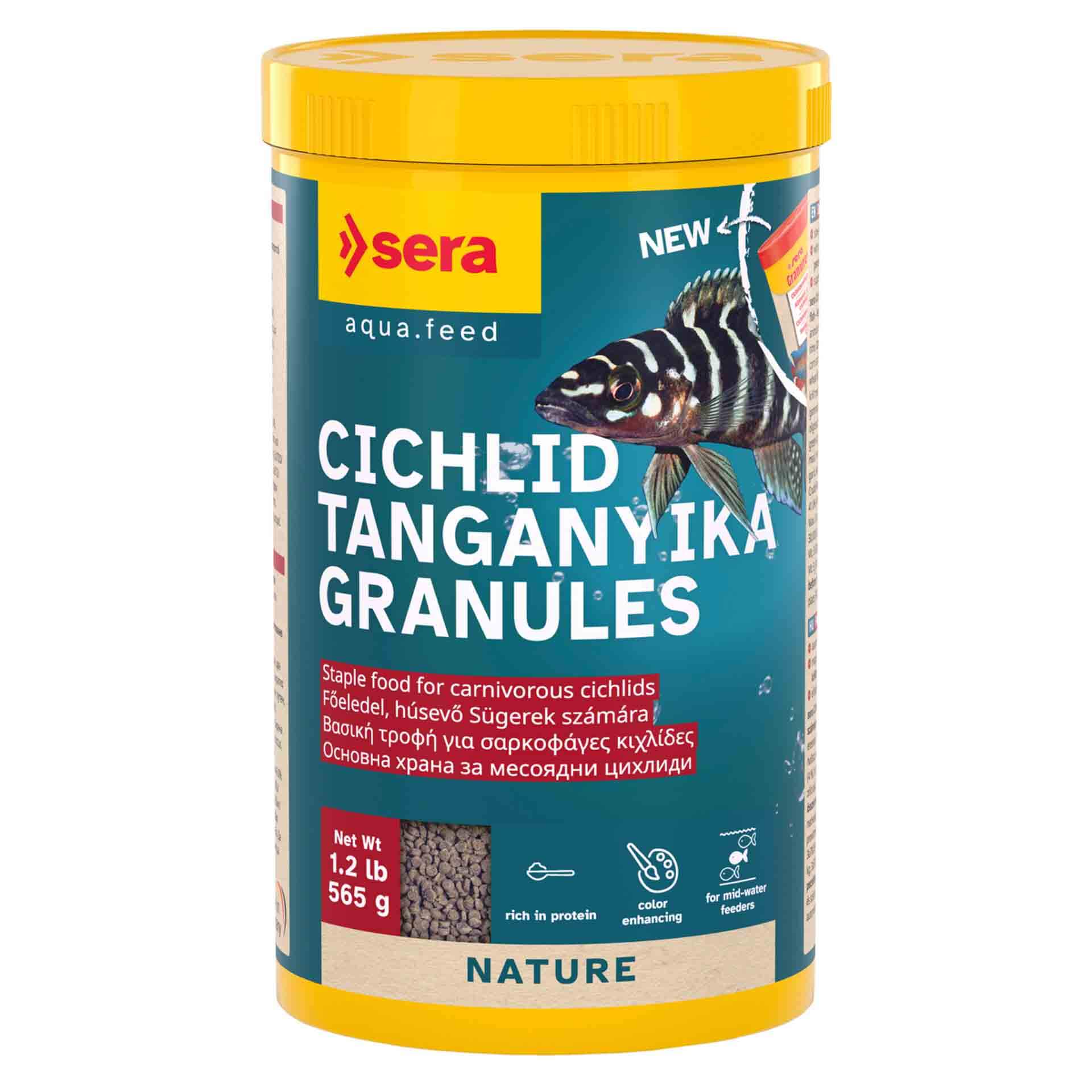
Sera Cichlid Tanganyika Granules 1000ML (565G)
Description
Staple food for carnivorous cichlids
- slow-sinking granules for mainly carnivorous cichlids
- with a high protein amount, valuable fats, and a high krill percentage
- supports natural colouration due to natural carotenoids
- for healthy development
- the granules retain their shape for a long time and do not cloud the water
Cichlid Tanganyika is the staple food consisting of gently manufactured granules without dyes and preservatives for mainly carnivorous, small cichlids and omnivores.
With their high protein amount and valuable fats rich in omega fatty acids, as well as the high krill amount (with many minerals, trace elements and carotenoids), the granules are particularly tasty, have an excellent digestibility, and support healthy development and colouration.
The slow-sinking granules retain their shape very well and do not pollute the water.
Nutrition close to nature for cichlids
Like most fish families, cichlids can be classified into three large groups in terms of their diet: carnivores (eating mainly animal matter), herbivores (eating mainly plants) and omnivores (eating all kinds of food). But even within each of these groups, there are numerous subgroups. In order to meet the different requirements, sera offers five different types of food for cichlids, that have been developed to match the feeding habits and sizes of the animals.
All sera aquarium foods belong to the “Nature” range and do not require any dyes or preservatives.
Nutrition close to nature for cichlids
Like most fish families, cichlids can be classified into three large groups in terms of their diet: carnivores (eating mainly animal matter), herbivores (eating mainly plants) and omnivores (eating all kinds of food). But even within each of these groups, there are numerous subgroups. In order to meet the different requirements, sera offers five different types of food for cichlids, that have been developed to match the feeding habits and sizes of the animals.
All sera aquarium foods belong to the “Nature” range and do not require any dyes or preservatives.
Complete feed for all cichlids
Feed once or twice daily, only as much as the animals take up within a short time.
fish meal, corn starch, wheat gluten, wheat flour, wheat germ, krill meal (4%), fish oil (4%), gammarus meal, mannan oligosaccharides, brewers yeast, green-lipped mussel meat meal, Haematococcus algae, garlic.
Crude Protein 44.0%, Crude Fat 7.5%, Crude Fiber 2.0%, Moisture 5.5%, Crude Ash 6.0%.
Vitamins and provitamins: 3a672a/Vit. A 30,000 IU/kg, 3a671/Vit. D3 1,500 IU/kg, 3a700/Vit. E 60 mg/kg, 3a820/Vit. B1 30 mg/kg, 3a825i/Vit. B2 90 mg/kg, 3a312/stab. Vit. C 550 mg/kg.
Description
Staple food for carnivorous cichlids
- slow-sinking granules for mainly carnivorous cichlids
- with a high protein amount, valuable fats, and a high krill percentage
- supports natural colouration due to natural carotenoids
- for healthy development
- the granules retain their shape for a long time and do not cloud the water
Cichlid Tanganyika is the staple food consisting of gently manufactured granules without dyes and preservatives for mainly carnivorous, small cichlids and omnivores.
With their high protein amount and valuable fats rich in omega fatty acids, as well as the high krill amount (with many minerals, trace elements and carotenoids), the granules are particularly tasty, have an excellent digestibility, and support healthy development and colouration.
The slow-sinking granules retain their shape very well and do not pollute the water.
Nutrition close to nature for cichlids
Like most fish families, cichlids can be classified into three large groups in terms of their diet: carnivores (eating mainly animal matter), herbivores (eating mainly plants) and omnivores (eating all kinds of food). But even within each of these groups, there are numerous subgroups. In order to meet the different requirements, sera offers five different types of food for cichlids, that have been developed to match the feeding habits and sizes of the animals.
All sera aquarium foods belong to the “Nature” range and do not require any dyes or preservatives.
Nutrition close to nature for cichlids
Like most fish families, cichlids can be classified into three large groups in terms of their diet: carnivores (eating mainly animal matter), herbivores (eating mainly plants) and omnivores (eating all kinds of food). But even within each of these groups, there are numerous subgroups. In order to meet the different requirements, sera offers five different types of food for cichlids, that have been developed to match the feeding habits and sizes of the animals.
All sera aquarium foods belong to the “Nature” range and do not require any dyes or preservatives.
Complete feed for all cichlids
Feed once or twice daily, only as much as the animals take up within a short time.
fish meal, corn starch, wheat gluten, wheat flour, wheat germ, krill meal (4%), fish oil (4%), gammarus meal, mannan oligosaccharides, brewers yeast, green-lipped mussel meat meal, Haematococcus algae, garlic.
Crude Protein 44.0%, Crude Fat 7.5%, Crude Fiber 2.0%, Moisture 5.5%, Crude Ash 6.0%.
Vitamins and provitamins: 3a672a/Vit. A 30,000 IU/kg, 3a671/Vit. D3 1,500 IU/kg, 3a700/Vit. E 60 mg/kg, 3a820/Vit. B1 30 mg/kg, 3a825i/Vit. B2 90 mg/kg, 3a312/stab. Vit. C 550 mg/kg.
Original: $30.92
-70%$30.92
$9.28Description
Description
Staple food for carnivorous cichlids
- slow-sinking granules for mainly carnivorous cichlids
- with a high protein amount, valuable fats, and a high krill percentage
- supports natural colouration due to natural carotenoids
- for healthy development
- the granules retain their shape for a long time and do not cloud the water
Cichlid Tanganyika is the staple food consisting of gently manufactured granules without dyes and preservatives for mainly carnivorous, small cichlids and omnivores.
With their high protein amount and valuable fats rich in omega fatty acids, as well as the high krill amount (with many minerals, trace elements and carotenoids), the granules are particularly tasty, have an excellent digestibility, and support healthy development and colouration.
The slow-sinking granules retain their shape very well and do not pollute the water.
Nutrition close to nature for cichlids
Like most fish families, cichlids can be classified into three large groups in terms of their diet: carnivores (eating mainly animal matter), herbivores (eating mainly plants) and omnivores (eating all kinds of food). But even within each of these groups, there are numerous subgroups. In order to meet the different requirements, sera offers five different types of food for cichlids, that have been developed to match the feeding habits and sizes of the animals.
All sera aquarium foods belong to the “Nature” range and do not require any dyes or preservatives.
Nutrition close to nature for cichlids
Like most fish families, cichlids can be classified into three large groups in terms of their diet: carnivores (eating mainly animal matter), herbivores (eating mainly plants) and omnivores (eating all kinds of food). But even within each of these groups, there are numerous subgroups. In order to meet the different requirements, sera offers five different types of food for cichlids, that have been developed to match the feeding habits and sizes of the animals.
All sera aquarium foods belong to the “Nature” range and do not require any dyes or preservatives.
Complete feed for all cichlids
Feed once or twice daily, only as much as the animals take up within a short time.
fish meal, corn starch, wheat gluten, wheat flour, wheat germ, krill meal (4%), fish oil (4%), gammarus meal, mannan oligosaccharides, brewers yeast, green-lipped mussel meat meal, Haematococcus algae, garlic.
Crude Protein 44.0%, Crude Fat 7.5%, Crude Fiber 2.0%, Moisture 5.5%, Crude Ash 6.0%.
Vitamins and provitamins: 3a672a/Vit. A 30,000 IU/kg, 3a671/Vit. D3 1,500 IU/kg, 3a700/Vit. E 60 mg/kg, 3a820/Vit. B1 30 mg/kg, 3a825i/Vit. B2 90 mg/kg, 3a312/stab. Vit. C 550 mg/kg.