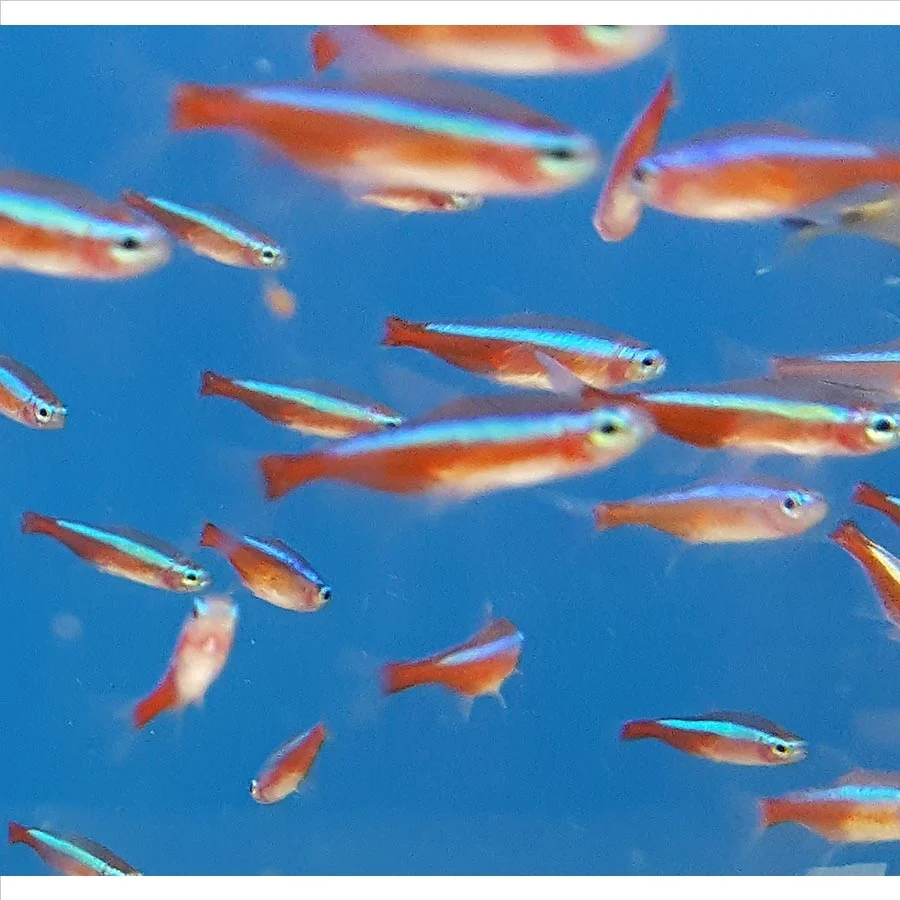

Laboutie Wrasse - (No Online Purchases)
Description
Cirrhilabrus laboutei
The Laboute's Wrasse, scientifically known as Cirrhilabrus laboutei, is a beautiful and sought-after species of wrasse, commonly known in the aquarium trade as the Laboute's Fairy Wrasse. It is named after Pierre Laboute, who first photographed the species.
Physical Characteristics
Colouration: The Laboute's Wrasse has a stunning and intricate pattern of colours. Males have a red to brownish back and a pale underside, often with a vibrant blue forehead. The body is adorned with magenta and pale blue stripes that run along the back and mid-body. Females have a similar pattern but with narrower, reddish stripes. The colors can vary depending on the individual's mood, age, and geographic origin.
Size: This species is relatively small, reaching a maximum total length of about 12 cm (4.7 inches).
Sexual Dimorphism: While both sexes have similar patterns, the male's colours are more vibrant and intensify during courtship displays.
Habitat and Behaviour
Native Range: Laboute's Wrasse is native to the Western Central Pacific, specifically found on coral reefs around New Caledonia, the Loyalty Islands, and the Great Barrier Reef in Australia.
Habitat: They inhabit rubble patches on seaward and back reef slopes at depths of 7 to 55 meters. They are often found near coral or rock formations where they can quickly hide.
Diet: They are carnivores, feeding primarily on small invertebrates and zooplankton in the wild.
Hermaphroditism: Like many other wrasses, they are protogynous hermaphrodites, meaning all individuals are born female and can change sex to male as they mature, particularly if the dominant male of a group is no longer present.
Sleeping Habits: Unlike many wrasse species that bury themselves in the sand at night, the Laboute's Wrasse finds a crevice or nook to sleep in and envelops itself in a protective mucus cocoon.
Aquarium Care
The Laboute's Wrasse is a peaceful and active fish that makes a great addition to a reef or fish-only aquarium.
Tank Requirements: A minimum tank size of 50 to 90 gallons is recommended, with plenty of live rock for hiding spots and exploration. A tight-fitting lid is essential as they are known to be jumpers.
Temperament: They are generally peaceful and do well in community tanks with other non-aggressive species.
Diet: In captivity, they readily accept a varied diet of high-quality marine flakes, pellets, and frozen meaty foods like mysis shrimp and brine shrimp.
- Origin:
- Adult Size:
- Social:
- Care:
Description
Cirrhilabrus laboutei
The Laboute's Wrasse, scientifically known as Cirrhilabrus laboutei, is a beautiful and sought-after species of wrasse, commonly known in the aquarium trade as the Laboute's Fairy Wrasse. It is named after Pierre Laboute, who first photographed the species.
Physical Characteristics
Colouration: The Laboute's Wrasse has a stunning and intricate pattern of colours. Males have a red to brownish back and a pale underside, often with a vibrant blue forehead. The body is adorned with magenta and pale blue stripes that run along the back and mid-body. Females have a similar pattern but with narrower, reddish stripes. The colors can vary depending on the individual's mood, age, and geographic origin.
Size: This species is relatively small, reaching a maximum total length of about 12 cm (4.7 inches).
Sexual Dimorphism: While both sexes have similar patterns, the male's colours are more vibrant and intensify during courtship displays.
Habitat and Behaviour
Native Range: Laboute's Wrasse is native to the Western Central Pacific, specifically found on coral reefs around New Caledonia, the Loyalty Islands, and the Great Barrier Reef in Australia.
Habitat: They inhabit rubble patches on seaward and back reef slopes at depths of 7 to 55 meters. They are often found near coral or rock formations where they can quickly hide.
Diet: They are carnivores, feeding primarily on small invertebrates and zooplankton in the wild.
Hermaphroditism: Like many other wrasses, they are protogynous hermaphrodites, meaning all individuals are born female and can change sex to male as they mature, particularly if the dominant male of a group is no longer present.
Sleeping Habits: Unlike many wrasse species that bury themselves in the sand at night, the Laboute's Wrasse finds a crevice or nook to sleep in and envelops itself in a protective mucus cocoon.
Aquarium Care
The Laboute's Wrasse is a peaceful and active fish that makes a great addition to a reef or fish-only aquarium.
Tank Requirements: A minimum tank size of 50 to 90 gallons is recommended, with plenty of live rock for hiding spots and exploration. A tight-fitting lid is essential as they are known to be jumpers.
Temperament: They are generally peaceful and do well in community tanks with other non-aggressive species.
Diet: In captivity, they readily accept a varied diet of high-quality marine flakes, pellets, and frozen meaty foods like mysis shrimp and brine shrimp.
- Origin:
- Adult Size:
- Social:
- Care:
Original: $55.03
-70%$55.03
$16.51Description
Description
Cirrhilabrus laboutei
The Laboute's Wrasse, scientifically known as Cirrhilabrus laboutei, is a beautiful and sought-after species of wrasse, commonly known in the aquarium trade as the Laboute's Fairy Wrasse. It is named after Pierre Laboute, who first photographed the species.
Physical Characteristics
Colouration: The Laboute's Wrasse has a stunning and intricate pattern of colours. Males have a red to brownish back and a pale underside, often with a vibrant blue forehead. The body is adorned with magenta and pale blue stripes that run along the back and mid-body. Females have a similar pattern but with narrower, reddish stripes. The colors can vary depending on the individual's mood, age, and geographic origin.
Size: This species is relatively small, reaching a maximum total length of about 12 cm (4.7 inches).
Sexual Dimorphism: While both sexes have similar patterns, the male's colours are more vibrant and intensify during courtship displays.
Habitat and Behaviour
Native Range: Laboute's Wrasse is native to the Western Central Pacific, specifically found on coral reefs around New Caledonia, the Loyalty Islands, and the Great Barrier Reef in Australia.
Habitat: They inhabit rubble patches on seaward and back reef slopes at depths of 7 to 55 meters. They are often found near coral or rock formations where they can quickly hide.
Diet: They are carnivores, feeding primarily on small invertebrates and zooplankton in the wild.
Hermaphroditism: Like many other wrasses, they are protogynous hermaphrodites, meaning all individuals are born female and can change sex to male as they mature, particularly if the dominant male of a group is no longer present.
Sleeping Habits: Unlike many wrasse species that bury themselves in the sand at night, the Laboute's Wrasse finds a crevice or nook to sleep in and envelops itself in a protective mucus cocoon.
Aquarium Care
The Laboute's Wrasse is a peaceful and active fish that makes a great addition to a reef or fish-only aquarium.
Tank Requirements: A minimum tank size of 50 to 90 gallons is recommended, with plenty of live rock for hiding spots and exploration. A tight-fitting lid is essential as they are known to be jumpers.
Temperament: They are generally peaceful and do well in community tanks with other non-aggressive species.
Diet: In captivity, they readily accept a varied diet of high-quality marine flakes, pellets, and frozen meaty foods like mysis shrimp and brine shrimp.
- Origin:
- Adult Size:
- Social:
- Care: